Why medical translation requires more than linguistic accuracy
Medical information must be accurate, but accuracy alone is not enough. Patients and healthcare professionals also need information that is clear, consistent and appropriate for the context in which it is used. This requires medical translators to combine linguistic expertise with medical knowledge and an understanding of regulatory requirements, target audiences and local healthcare contexts.
29.9.2026
By: Lotta Holmström, Team Lead Translations, Oriola
At Oriola, our purpose is Health for Life. Our in-house medical translation team supports this purpose by helping pharmaceutical companies make important medical information available to patients and healthcare professionals in local languages across the Nordics.
Medical translation covers many types of content, including product information, clinical trial documentation and patient support materials. Each document has a particular purpose and audience. Medical translators therefore need to understand not only what the source text says, but also who will use the translated information and in what context.

Healthcare professionals rely on accurate and consistent information when making treatment decisions and advising patients. High-quality medical translations therefore play an important role in both patient and medication safety.
For patients, access to information in their own language is an important part of better understanding their medications and treatments. Clear and reliable translations make medical information more accessible and support the safe and effective use of medicines.
Consistent terminology helps readers navigate medical information
Information about the same medicine is often published across multiple documents and channels. Patients and healthcare professionals may encounter it in package leaflets, educational materials and on websites. Using consistent terminology helps ensure that information is recognised and understood in the same way regardless of where it appears.
For example, one document may refer to discontinuing treatment, while another uses stopping treatment. Both expressions may be correct, but consistent terminology makes it easier for readers to recognise that both documents refer to the same action.
Similarly, a package leaflet may refer to heart failure, while a patient support programme uses cardiac insufficiency. Although both terms describe the same condition, using different terminology across materials can create unnecessary confusion for patients who encounter information through several channels.
Different audiences may need different language
One of the challenges of medical translation is finding the right balance between scientific precision and readability. The terminology used in a product information text may not always be the language that best serves patients reading an educational brochure or patient guide.
For example, healthcare professionals are familiar with the term exacerbation, whereas patients may better understand worsening of symptoms. Likewise, a scientific text may refer to a myocardial infarction, while the more patient-friendly term is heart attack. The meaning remains the same, but the wording is adapted to help readers understand the information.
Understanding the different needs of different readers is crucial in order to be able to communicate complex medical information in a way that is accurate, understandable and appropriate for the intended audience.
Context determines the right translation
A high-quality medical translation involves more than just finding the equivalent words in another language. A direct translation can be linguistically correct while still sounding unnatural, unclear or even misleading in the target language. Translators need to consider how the information will be interpreted by patients and healthcare professionals in the local context.
A good example is the English term caregiver. Depending on the context, it may refer to a family member, a personal assistant or a healthcare professional. A direct translation may therefore be technically correct while still failing to convey the intended meaning to local readers.
Some of the information in a translated text may also need to be adapted for local audiences. The original text may have been written with a specific country and healthcare system in mind, and some details may not be relevant or applicable to another country or system. A professional medical translator will notify clients of these kinds of potential issues and suggest adaptations where needed.
This is why medical translation requires an understanding of different healthcare systems, patient needs and the context in which information will be used.
Helping readers focus on what matters
Every medical translation involves a series of informed decisions. Translators assess terminology, context, purpose and audience while ensuring that the translated content remains accurate and reliable.
“The work we do feels very valuable because readers can rely on the accuracy of our translations. They can focus on the important and sometimes complex content without having to struggle with the language.” (Heidi Aho, Translator).
These decisions often remain invisible to the person reading the final text. However, they are essential to making complex information understandable and useful in another language.
Medical translation calls for specialised knowledge, careful research and the ability to recognise when a seemingly small linguistic choice could affect how the information is interpreted.
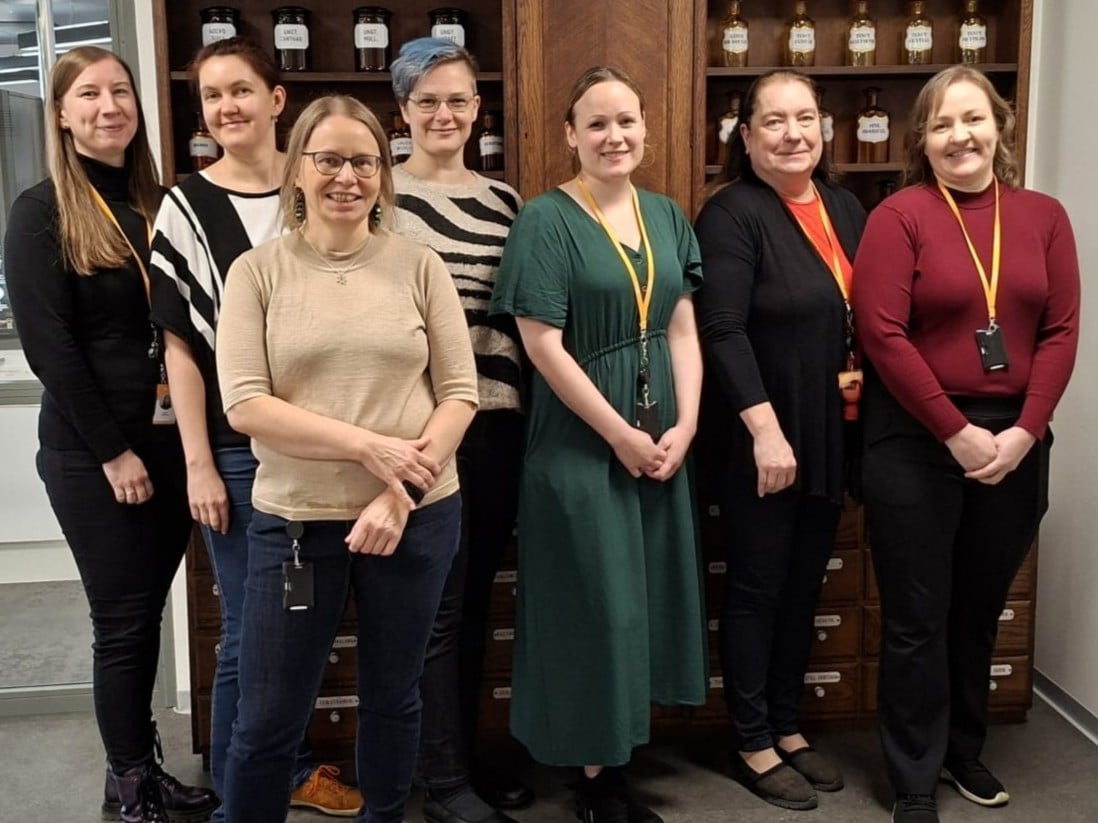
Oriola’s Medical translations team
Oriola’s in-house medical translation team supports pharmaceutical and healthcare companies with specialised translation services for Nordic markets. By combining linguistic expertise with knowledge of medical terminology, regulatory requirements and local contexts, the team helps make important medical information available to the people who need it.
On International Translation Day, we recognise the expertise of translators and language professionals who help information cross linguistic and national boundaries without losing its meaning.